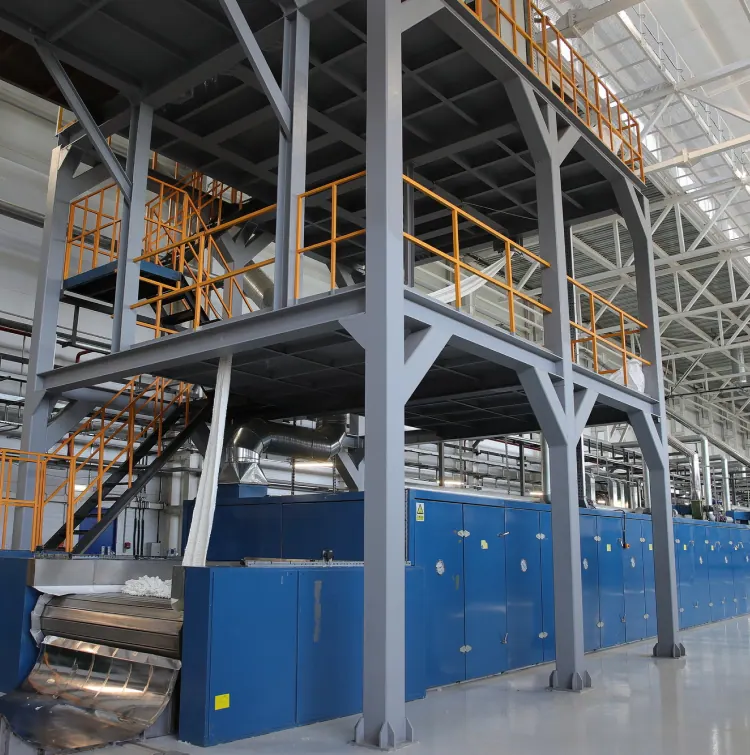
From molecule to bale
A continuous direct-spinning process: polyethylene terephthalate synthesis, tow spinning, finishing and drawing, heat setting, cutting and baling.
Polyethylene terephthalate synthesis
A two-stage process: esterification of terephthalic acid with ethylene glycol, followed by polycondensation under vacuum. This is where the properties of the future fibre are laid down.
- Esterification: 240–260 °C, pressure 0.2–0.3 MPa, 3–4 hours. Catalyst — triglycolate or antimony trioxide Sb₂O₃
- Partial oligomerisation of BHET starts already at esterification — short PET chains appear in the reaction mass
- Pre-polycondensation: 270–280 °C, vacuum 100–200 Pa, 2–3 hours — the molecular weight of the oligomers grows
- Final polycondensation: 280–290 °C, deep vacuum below 100 Pa, 3–4 hours to a melt viscosity of 0.6–0.7 dl/g
- Matting agent: titanium dioxide TiO₂, 0.2–0.5% of the PET mass, introduced at the esterification stage — it gives the fibre a matt shade and improves its textile properties
- The finished melt is routed either to spinning or to the granulate production unit
Tow spinning
The melt from the final polycondensation reactor passes through polymer filters and is forced through the spinnerets of the spinning machine.
- Each spinneret pack comprises a high-precision metering pump, a multi-stage filter and a spinneret with several thousand holes 0.2–0.4 mm in diameter
- Extrusion pressure of 10–15 MPa at a constant flow rate: the uniformity of delivery determines the evenness of the future fibre
- Melt temperature 285–295 °C, spinning speed 800–1,200 m/min
- The melt streams become filaments under uniform air cooling in the cross-flow quench chamber
- For smoothness and antistatic properties the filament is treated with a spin finish based on mineral oils and surfactants — this reduces breaks during winding
- The cooled filament bundles are gathered by deflector rolls into a combined tow at the take-up units, receive initial drawing and are laid in cans
- Before finishing, the tow is held for about 24 hours
Finishing and drawing
Tow from the cans is gathered in a creel, laid out into a sheet and drawn in successive stages.
- Drawing runs across three units: the tow becomes finer and longer under an external force
- Draw ratio of 300–400%, depending on the required fibre properties
- Drawing temperature 80–100 °C — steam heating
- Before drawing, the sheet is pre-heated for plasticity and treated with spin finish again: it compensates for losses in the preceding operations and prevents filament breaks
Crimping and heat setting
The tow is given crimp, which improves the interlocking of fibres in yarn. The fibre then passes through the heat-setting oven.
- Residual stresses created during drawing are relieved
- Crystallinity and fibre elasticity increase
- Heat shrinkage is reduced — fibre dimensions are stabilised
- Residual moisture is removed: the level falls below 0.1%
- Heat setting parameters: 180–220 °C, dwell time 10–30 minutes
Cutting, baling and labelling
The dried tow is cut into fibres of the required length and pressed into bales.
- Cut length of 32–64 mm for textile applications (up to 66 mm on request)
- A 370 kg bale is formed in the baling press
- The bale is wrapped in polyethylene film, weighed and labelled
- The label states: fibre type, linear density, cut length, lot number and production date
Advantages of direct spinning
Direct spinning does away with the intermediate granulation of the polymer — a gain in both cost and quality.
- Lower energy consumption: the granulation and re-melting stage is eliminated
- Better physical and mechanical properties: thermal degradation of the polymer is minimal, because the melt does not go through an extra heating cycle
- Process continuity: all stages run in a single process stream
Every lot is tested to GOST
- Linear density (tex) — GOST 10213.1
- Strength (cN/tex) — GOST 10213.2
- Elongation at break (%) — GOST 10213.2
- Spin finish content (%) — solvent extraction
- Moisture content (%) — drying at 105 °C
- Heat shrinkage (%) — oven test
- Number of defects per 1 kg
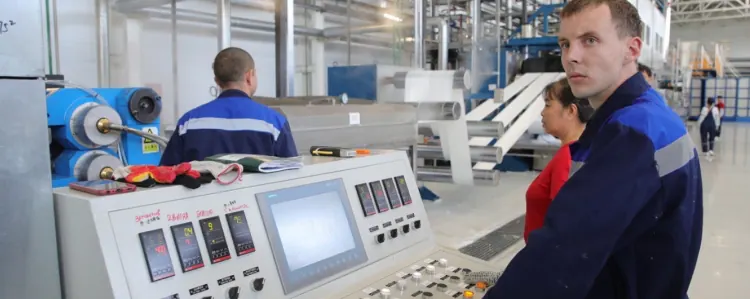
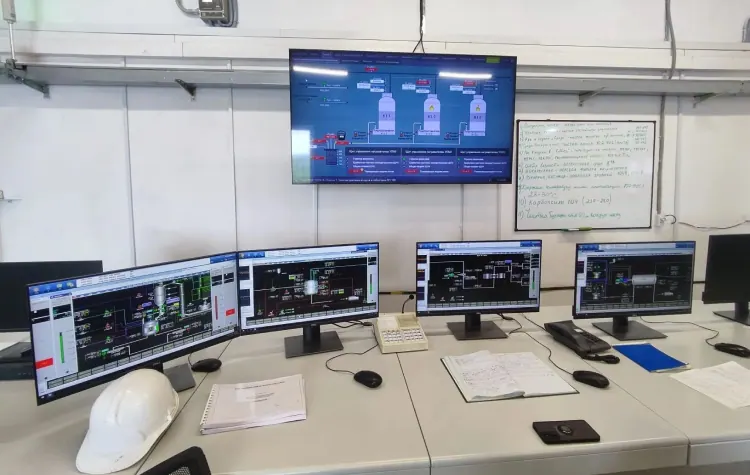
Minimal human factor
- Automatic temperature and pressure control at every stage
- Robotic cutting and baling lines
- Digital process monitoring in real time
- Modern quality control laboratory
Two plants
Fibre is produced at the head site in Shakhty. Nonwoven web and wipes output is split between Shakhty and Tosno.
Rostov Region
Polyester fibre · Spunlace · Wet wipes
Leningrad Region
Spunlace · Wet wipes
Need the technical parameters of a lot?
We will provide a quality certificate and test reports for the grade you are interested in.